


Quick facts
UNESCO status
World Heritage since 2005 (extended 2008 to include Berat)
From Tirana
~230 km · 3h30 on SH4
From Sarandë
60 km · 1h over the Muzinë pass
Avg budget/day
€45 backpacker · €75 mid · €130 comfort
Best months
May, early Jun, Sep, early Oct
Main draws
Stone-roofed Ottoman houses · hilltop castle · Enver Hoxha birthplace museum · Cold War tunnel
Overview: the Stone City
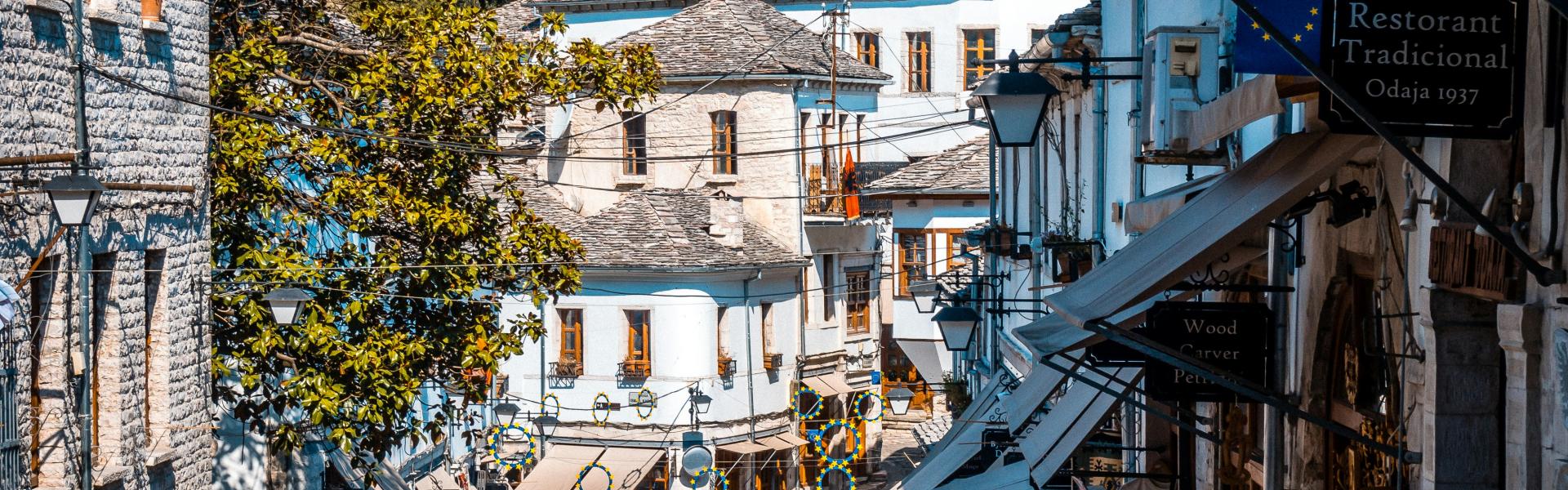
Gjirokastër (Argirocastro in Italian, Gjirokastra in German usage) sits on the steep western flank of Mount Mali i Gjerë, its silver-grey slate rooftops cascading in tight terraces down to the Drino Valley. Locals call it Qyteti i Gurtë, the Stone City, because almost every surface is cut from the same dressed limestone: house walls, cobbled lanes, staircases, courtyard cisterns and the enormous kalaja that crowns the ridge. The historic centre has been on the UNESCO World Heritage list since 2005, protected with fellow Ottoman town Berat as a rare surviving Balkan Ottoman-era urban landscape.
Gjirokastër is also the birthplace of two figures who dominate modern Albanian identity: the novelist Ismail Kadare, whose Chronicle in Stone is set here, and the isolationist dictator Enver Hoxha, who ruled Albania from 1944 to 1985. Both grew up in the same neighbourhood of stone tower-houses that still stands. Two nights is the sweet spot: castle, two Ottoman kullë interiors, the Cold War bunker, and one evening of qifqi and slow-cooked lamb in the bazaar.
Getting to Gjirokastër
By car from Tirana
230 km on the SH4, the main north-south corridor. Around 3h30-4h depending on Fier traffic and the mountain climb south of Tepelenë. Rental from TIA starts around €35/day in shoulder season. Park at the bazaar lot or on Rruga Xhemal Bushati; the old town is pedestrianised.
By car from Sarandë
60 km · 1 hour scenic climb over the Muzinë pass. Consider stopping at the Blue Eye spring either way. This is the easiest approach and the one most Riviera visitors use.
From Greece via Kakavia border
Only 25 minutes from the Kakavia crossing on the Greek-Albanian border. Ideal for combining Ioannina, Meteora or Corfu with southern Albania. Rental cars must be declared at the border; check paperwork with your rental company.
By bus / furgon
Direct services from Tirana Regional Terminal roughly every 90 minutes (05:00-15:00), 4-5 hours, 1,500-1,800 ALL (€15-18). From Sarandë port, minivans leave through the morning, ~75 minutes. The Gjirokastër terminal is on the SH4 at the foot of the hill — taxi or steep 15-minute walk up.
When to visit — month by month
Mediterranean-mountain microclimate: hotter and drier than the coast in summer, sharply colder in winter with occasional snow. Stone stores heat all afternoon, so July-August alleys are uncomfortable between 13:00 and 17:00. Spring and early autumn are ideal.
| Month | Weather | Verdict |
|---|---|---|
| January | 9°C · wet · rare snow · many restaurants shut | Avoid |
| February | 10°C · wet · low light on castle stonework | Avoid |
| March | 13°C · chilly mornings · wildflowers in Drino | OK |
| April | 17°C · green landscapes · few tourists | Good |
| May | 22°C · prime · long days, warm castle light | Best |
| June | 27°C · warm but bearable · high season from mid-month | Best |
| July | 32°C · hot afternoons · visit castle at 08:30 or after 17:00 | OK |
| August | 33°C · peak heat + peak crowds · Folk Festival years worth planning | Avoid |
| September | 27°C · prime · warm evenings, empty castle, harvest food | Best |
| October | 21°C · excellent through mid-month · autumn on Mali i Gjerë | Good |
| November | 15°C · wet and moody · bazaar to yourself | OK |
| December | 10°C · cold and rainy · empty streets | Avoid |
Top experiences in Gjirokastër
Gjirokastër Castle (Kalaja)
One of the largest castles in the Balkans, 400 m along the ridge above the old town. Captured WWII Italian and German artillery, the National Museum of Armaments, and the wreckage of a US Air Force training jet Hoxha exhibited as a spy plane. Allow 2 hours.
The Old Bazaar (Pazari i Vjetër)
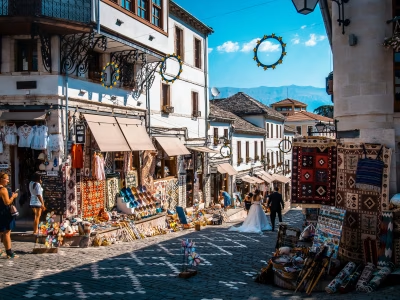
The historic commercial spine at the foot of the castle rock, rebuilt after a 1937 fire on the 17th-century plans. Stone shopfronts sell qeleshe felt caps, kilim rugs, brass coffee pots and embroidered textiles. Come in the morning to shop; return in the evening when cafés spill onto the street.
Zekate House
The most spectacular surviving Ottoman kullë, built 1811-1812 by governor Beqir Zeko. Symmetrical wings, painted ceilings, first-floor divan with panoramic windows over the Drino Valley. The builders' descendants show you around personally. Entry ~400 ALL, 45 minutes.
Skenduli House
Slightly older than Zekate (mostly 18th century) and, unlike restored versions, still lived in by the Skenduli family. The owner explains kullë defence architecture — loopholes, murder holes, hidden emergency hatch — from 250 years of family ownership. Entry ~400 ALL.
Cold War Tunnel
Beneath the old town, Hoxha's regime built a 2.5 km underground bunker complex to shelter regional officials in a nuclear attack. Opened in 2014, a half-hour guided walk passes decontamination chambers, a communications room and the office reserved for Hoxha himself. Meet behind the town hall; ~200 ALL, tours on the hour.
Ethnographic Museum (Hoxha birthplace)
Built where Hoxha was born and grew up, this reconstructed kullë is now Gjirokastër's Ethnographic Museum. Excellent 19th-century domestic objects across three floors — kilims, kitchen tools, wedding dress, saddlery. Views from the top divan rank among the best in the old town.
Obelisk viewpoint
Above the old town stands the Obelisk, a monument to the first Albanian-language school opened here in 1908. A short but steep 20-minute walk from the bazaar delivers the classic photograph: slate rooftops fanning down the mountain, castle above, Drino Valley beyond. Best at sunset.
Ali Pasha aqueduct + Antigonea
Two Drino Valley add-ons worth a car. The Ali Pasha aqueduct near Libohovë fed the Gjirokastër castle in the early 19th century, atmospheric ruins across a hillside. Antigonea archaeological park sits on the ridge opposite, a 3rd-century BC Illyrian city founded by King Pyrrhus of Epirus, panoramic views back to the Stone City.
Where to stay
Sleeping inside the UNESCO old town is the whole point. Book a restored kullë guesthouse rather than a modern hotel down the hill. Palorto is the highest quarter, closest to the castle — steepest streets, best views, quietest at night. Manalat, mid-slope near Skenduli and Zekate, is more central.
Top-end: Kotoni Hotel, Stone City Hostel, Argjiro Hotel. Mid-range: Guest House Argjiro Castle, Guest House Fantasy. Budget: any family-run bujtinë, 25-40 € per double with breakfast. Book two months ahead for July, August and every June or September weekend. Guesthouses meet you at the old-town edge because you cannot drive to the door.
Where to eat
Gjirokastër has its own culinary identity, distinct from the coast. The signature dish is qifqi, little rice-and-egg balls with fresh mint, native to this town. Also try pasha qofte meatballs in tomato sauce and oshaf, dried figs stewed with sheep's-milk cream. Slow-roasted lamb, spinach byrek and stuffed vine leaves complete the local canon.
Reliable tables: Taverna Kuka (traditional, valley-view terrace), Odaja (refined, strong wine list), Taverna Tradicionale (hearty qifqi, budget-friendly), Restorant Fantazia (panoramic terrace above the bazaar). Reserve on summer weekends. For espresso, Turkish coffee and sweet raki, sit in the bazaar between the Ethnographic Museum and the Old Mosque. Broader context in our Albanian food guide.
Nearby destinations
Gjirokastër is the natural base for the Drino Valley and southern Albania. Half-day and day trips in every direction.
Blue Eye (Syri i Kaltër)
25 km south · karst spring of impossibly blue water
Sarandë
60 km · 1h · Riviera port, ferry to Corfu
Butrint
75 km · UNESCO Greek-Roman-Venetian ruins on a lagoon
Antigonea archaeological park
Across the Drino Valley · Illyrian city of King Pyrrhus
Përmet + Bënjë thermal springs
40 min north · free open-air hot pools on the wild Vjosa
Zagoria valley villages
Stone-built mountain hamlets · guided hikes and family guesthouses
Sample itineraries
- 09:00 Gjirokastër Castle (armaments museum, US jet)
- 11:30 Zekate House, walk down through Palorto
- 13:00 Qifqi lunch at Taverna Kuka
- 15:00 Cold War tunnel, guided
- 16:30 Bazaar shopping
- 18:30 Obelisk viewpoint for sunset
- 20:30 Outdoor dinner in the bazaar
Frequently asked questions
1How many days do I need in Gjirokastër?
Two full days is the sweet spot for the town. Add a third if you want the Drino Valley (Blue Eye, Bënjë thermal springs, Antigonea) or a connection to Sarandë and Butrint. One day is a rushed minimum from Sarandë.
2How do I visit the Cold War tunnel?
Meet at the entrance behind the town hall (Bashkia). Tickets ~200 ALL, guided tours on the hour in main season. Guide-only entry; the tunnel is unlit and 2.5 km of forks. Bring a light layer even in August — underground temperature stays around 15 °C.
3Is Enver Hoxha's birthplace open to visitors?
Yes. The original house burned in 1916; a reconstructed kullë on the same site now houses the Ethnographic Museum. Open daily, ~200 ALL. Exhibits focus on 19th-century Albanian domestic life rather than Hoxha personally, but the site's biography is inseparable from the visit.
4Which Ottoman-house museum is best — Zekate or Skenduli?
Do both if you can — 10 minutes apart. Zekate is more spectacular architecturally (twin symmetrical wings, painted ceilings). Skenduli is intimate and often toured by the owner himself. If you pick one: Zekate for the wow, Skenduli for the story.
5Is Gjirokastër walkable?
Yes — the old town is compact and pedestrianised. But it is genuinely steep in places, with slippery limestone cobbles worn smooth by centuries. Wear proper shoes with grip. Rolling suitcases do not work; guesthouses meet you at the edge and help with luggage.
6Do I need a car?
Not for the old town — park at the edge and walk. But a car unlocks the Drino Valley: Blue Eye, Antigonea, Ali Pasha aqueduct, Bënjë springs, Zagoria villages. Without one, minivans reach the Blue Eye and Sarandë, and organised day tours cover the rest.
7Gjirokastër or Berat — which UNESCO town first?
Different, not one better. Berat is famous for its whitewashed "Thousand Windows" quarters facing across the Osum river. Gjirokastër is steeper, monochrome silver-grey stone, dominated by a single massive castle. Do both if time allows — 3 hours apart on the SH4.
8Can I visit Gjirokastër as a day trip from Sarandë?
Yes, easily. 60 km / 1 hour by car or minivan. Leave at 09:00, be at the castle by 10:30, back on the seafront for dinner. A stop at the Blue Eye on the return leg is strongly recommended. But you will miss the evening bazaar — two nights is much better.
9Is Gjirokastër safe?
Very. Albania has low violent crime overall, and Gjirokastër is a small, tightly-knit town where visitors are welcomed. The main hazard is the steep, slippery cobblestones — wear proper shoes. Women travel solo without issues.
Trips visiting Gjirokastër
Ready for Albania?
Ready to visit Gjirokastër?
Book a Stone City multi-day tour from Tirana, combine Gjirokastër with the Blue Eye and Sarandë, or pair it with Berat for the classic southern-Albania UNESCO loop.
Instant online quote — free cancellation up to 48 hours before pickup.