


Quick facts
UNESCO status
World Heritage since 2008, jointly with Gjirokastër
From Tirana
100 km · 1h 45m on SH4 · 120 km from TIA airport
From Vlorë
90 km inland · 1h 30m via SH4
Avg budget/day
€30 backpacker · €55 mid · €120 comfort
Best months
Late Apr–mid Jun, Sep–late Oct (wine harvest)
Main draws
Ottoman old town · still-inhabited castle · Onufri Museum
Overview: the City of a Thousand Windows
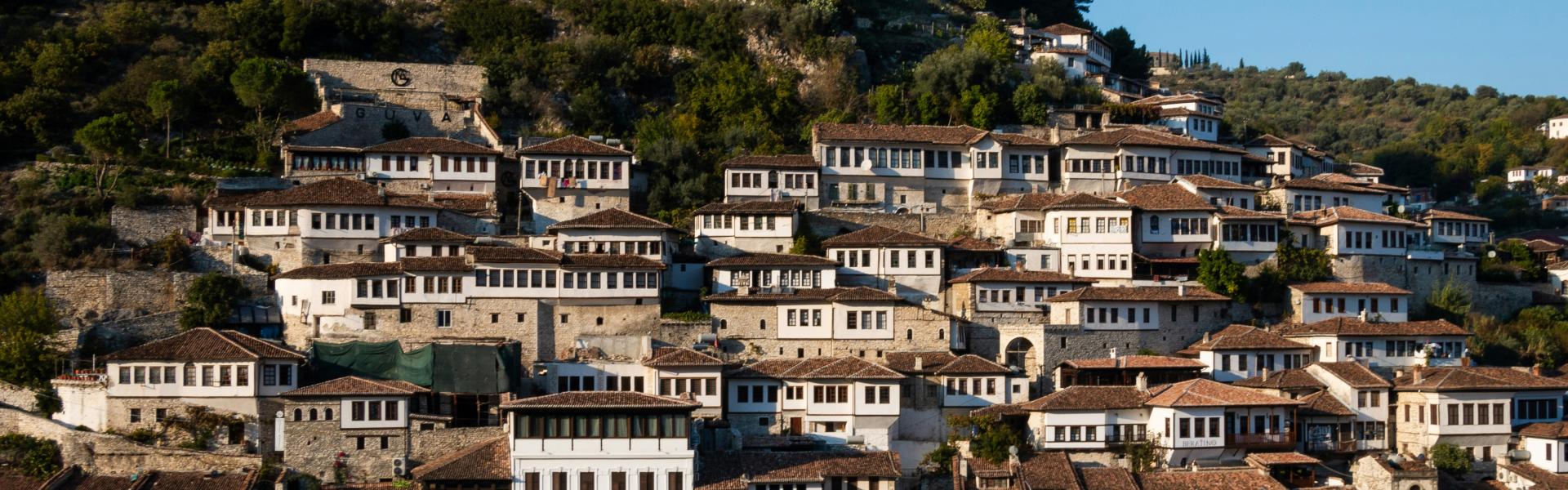
Berat is the town every Albania trip pivots around. UNESCO added it to the World Heritage list in 2008 as one of the last surviving Ottoman-period urban ensembles in the Balkans, and one look explains why: two facing hillsides of white stone-and-timber houses, each pierced with tall wooden windows that catch the afternoon light and give the town its most famous nickname, the City of a Thousand Windows. Between them runs the Osum, a shallow, fast-flowing river fed by the Tomorr massif to the east.
The Muslim quarter of Mangalem cascades down from the castle wall on the south bank; the Christian quarter of Gorica mirrors it across the river. Above both, on a ridge 210 m up, sits the largest inhabited castle in the Balkans, with around a thousand permanent residents still farming, walking their goats and locking the medieval gate at night. Add Albania's oldest continuously producing wine region, an outstanding Byzantine icon museum, and easy access to the Osum Canyon, and Berat becomes the essential cultural anchor between the coast and Gjirokastër.
Getting to Berat
From Tirana or TIA airport
SH4 from Tirana: 100 km, 1h 45m, no tolls. From TIA airport: 120 km, 2h to 2h 15m door to door. Private transfer €90–120, rental car from €35/day at TIA in shoulder season. Parking in Berat is free just outside the pedestrian core.
By bus or furgon from Tirana
Regional buses and shared minibuses (furgon) leave the Terminali i Jugut in Kashar, on the western ring road, every 30–45 minutes between 06:30 and 17:00. Fare 400 ALL (about €4), journey 2h 15m. Return service is equally frequent.
From the coast (Vlorë, Durrës, Sarandë)
From Vlorë: 90 km inland, 1h 30m via SH4 through Fier and Lushnjë. From Durrës port: 95 km, 1h 30m. From Sarandë: 190 km, 3h 30m — better as an overnight than a single push. The classic Albania week pairs a Riviera swim day with one inland day in Berat.
Onward to Gjirokastër or the Osum Canyon
South to Gjirokastër: 140 km, 2h 30m via SH4/SH72. East into the Tomorr mountains and the Osum Canyon: 60 km to Çorovodë, 1h 15m. West to Apollonia and Ardenica: 50 km, 45m. Berat sits at a natural pivot for southern-Albania culture loops.
When to visit — month by month
Berat is beautiful year-round, but the shoulder seasons win. Aim for the last week of May or the second week of September: long dry days, low crowds, open wineries. Winters are mild but wet and cold at the castle.
| Month | Weather | Verdict |
|---|---|---|
| January | 4–12°C · rainy · quietest month · some restaurants closed | Avoid |
| February | 5–13°C · wetter · winter light on castle walls | Avoid |
| March | 7–16°C · wildflowers on castle hill · Osum starts to fill | OK |
| April | 10–19°C · perfect walking weather · Easter processions | Good |
| May | 14–24°C · peak shoulder · long evenings · wine cellars open | Best |
| June | 18–29°C · last comfortable summer month · pair with Riviera swim | Good |
| July | 21–33°C · full festival season · castle punishing at midday | OK |
| August | 22–34°C · Ferragosto crowds · book two weeks ahead | OK |
| September | 17–28°C · wine harvest · single best month for cellars | Best |
| October | 12–22°C · gold light on facades · mushroom season | Best |
| November | 8–17°C · olive harvest · new-vintage tastings | Good |
| December | 5–13°C · Christmas markets on the main square | OK |
Top experiences in Berat
Berat Castle — the inhabited citadel
Built on a ridge 210 m above the river, the outer walls run for 1,400 m and enclose 9.6 hectares, larger than the old town of Dubrovnik. Around a thousand people still live inside: whitewashed houses, vegetable gardens, working churches. Admission 400 ALL. Allow 2 to 3 hours.
Onufri National Iconographic Museum
Housed inside the citadel's 18th-century Dormition Cathedral. Named after Onufri of Neokastro, the 16th-century master whose deep-red pigment technique was lost with him. Over 100 icons, complete iconostases, the original wooden templon still in place. Entrance 400 ALL.
Mangalem quarter and the King Mosque
The historically Muslim quarter on the south bank, stacked in tiers below the castle wall. Walk up through the narrow lanes to the King Mosque (Xhamia e Mbretit) and the Halveti Tekke, a Bektashi Sufi lodge with one of the finest carved wooden ceilings in the country.
Gorica bridge and Gorica quarter
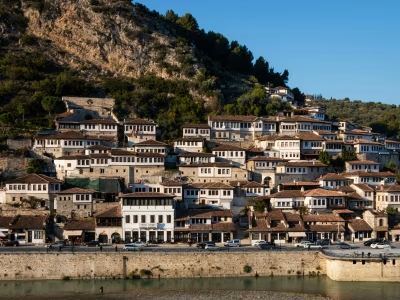
The 18th-century Ottoman stone Gorica bridge (Ura e Goricës) is where the classic postcard view of Mangalem is taken in late afternoon. Cross it to the historically Christian quarter of Gorica — smaller, quieter, softer light, and the best evening walk in Berat past the Church of Saint Thomas.
Ethnographic Museum
Housed in a fully preserved 18th-century Mangalem residence. Shows exactly how these houses worked as homes: ground-floor stable, first-floor women's quarters (haremlik), raised salon (oda) with carved ceiling. A 30-minute visit that adds huge context to everything else.
Cobo Winery and Puls/Vlosh tastings
Berat is Albania's oldest continuously producing wine region, documented since the 6th century BC. Indigenous grapes to look for: white Puls, red Vlosh. Visit Cobo Winery (10 km east, reserve ahead), Nurellari or Alpeza. Tastings with cheese, olives and cured meat run €15–25 per person.
Osum Canyon and Bogovë waterfall
Sixty kilometres east, the Osum carves a 26 km limestone canyon up to 100 m deep. April to June: rafted and kayaked with snowmelt. From July: an easy walk between the vertical walls. Combine with the 25 m Bogovë waterfall in a pine forest for a full day trip.
Ardenica Monastery and Apollonia
Fifty kilometres west, on the plain of Myzeqe, the 13th-century Ardenica Monastery retains original 18th-century frescoes by the Zografi brothers. Nearby, the ancient Greek city of Apollonia (founded 588 BC) spreads across a windy plateau. The classic Berat half-day companion.
Where to stay
Ottoman-house guesthouses in Mangalem or Gorica are Berat's signature stay: restored 4-to-8-room properties, family run, breakfast on a wooden veranda overlooking the river. €35–55 for a double in shoulder season, €70–110 for a boutique property. If you can, book inside the castle walls — sleeping within the fortress is one of Albania's rare experiences, and evenings up there are magical once the day-trippers have left.
For families or larger groups, standard hotels along Bulevardi Republika offer lifts and parking. Two to three weeks ahead is sensible in July, August and the mid-September to early October wine-harvest window.
Where to eat
Berat's food is inland Mediterranean: lamb, cheese, olive oil, wild greens, freshwater trout from the Devoll river, pomegranates in autumn. Local dishes to try: tavë kosi (lamb baked in a yoghurt-and-egg custard, Albania's national dish and often called best-in-country in Berat), fërgesë e Beratit (a hot skillet of peppers, tomatoes and cottage cheese, unmissable), trofte në zjarr (river trout grilled whole over embers), byrek me hithra (savoury nettle-and-cheese filo pie) and kaçkavall yellow cheese from the Wednesday market.
Reliable places include Homemade Food Lili (a home-restaurant in a Mangalem house, book ahead), the Mangalemi Hotel rooftop for the castle view, and Antigoni in Gorica for the trout. Expect €10–18 per person for a full meal with wine. Finish with a small glass of Kallmet or a mountain rakia.
Nearby destinations
Berat sits at a natural pivot for southern Albania. Half-day and full-day excursions run in every direction.
Osum Canyon
60 km east · 1h 15m · 26 km limestone canyon, rafting Apr–Jun
Apollonia archaeological park
50 km west · 45 min · Greek-Roman ruins on a windy plateau
Ardenica Monastery
50 km west · 45 min · 13th-century monastery with Zografi frescoes
Vlorë
90 km southwest · 1h 30m · gateway to the Riviera and marine park
Gjirokastër
140 km south · 2h 30m · Berat's UNESCO sister, the Stone City
Bogovë waterfall
55 km east · 1h · 25 m cascade in a pine forest
Sample itineraries
- 07:30 Depart Tirana (bus, transfer or guided tour)
- 10:00 Arrive, walk through Mangalem from the Gorica bridge viewpoint
- 10:30 Climb to Berat Castle (steep 15 min, taxi 300 ALL if preferred)
- 11:00 Onufri Museum + full citadel circuit
- 13:00 Lunch inside the castle — tavë kosi and local wine
- 14:30 Descend, cross the Gorica bridge to the quieter quarter
- 15:30 Ethnographic Museum in Mangalem
- 16:30 Wine tasting at Cobo Winery or an in-town cellar
- 18:00 Sunset on the river, return to Tirana
Frequently asked questions
1How long do I need in Berat?
A full day is enough for the castle, the Onufri Museum, and both Mangalem and Gorica quarters. Two days let you add a wine tasting plus either Ardenica and Apollonia or the Osum Canyon. Three days make sense if you also want a slow evening in Gjirokastër.
2Why is Berat called the City of a Thousand Windows?
The nickname refers to the tall wooden windows of the Ottoman-period houses stacked in tiers up the Mangalem and Gorica hillsides. Each house rises three or four storeys with a full row of glazed windows on the river-facing side. Seen from the Gorica bridge in late afternoon, the entire hillside looks like one continuous curtain of glass.
3Best month to visit Berat?
The last week of May and the second week of September are both close to perfect: long dry days, mild temperatures, low crowds, wineries open. September wins by a nose for the wine harvest itself; May wins for wildflowers on the castle hill.
4Can you visit the castle at night?
The main gate stays open into the evening and the streets inside are public, so a night walk is possible and highly recommended, especially if you stay at a castle-inside guesthouse. The museums close by 18:00 in summer, earlier in winter. Bring a light: some lanes are dim.
5Is Berat expensive?
No — Berat is one of Albania's best-value destinations. Guesthouse doubles from €35, a full dinner with wine €10–18 per person, castle admission and Onufri each 400 ALL (about €4), wine tastings €15–25. A comfortable mid-range day costs around €55.
6Wine tasting options in Berat?
Three main cellars run reliable tastings by reservation: Cobo Winery (10 km east, the classic choice — flagship producer of Puls and Vlosh), Nurellari and Alpeza. Most tastings include a plate of local cheese, olives and cured meat and run €15–25 per person. Book 24–48h ahead in shoulder season, longer in the September harvest window.
7Can Berat be done as a day trip from Tirana?
Yes. This is the most common way to visit. The drive is about 1h 45m each way; a guided day tour typically departs Tirana around 07:30 and returns by 19:00. Overnighting is nicer, but a single day is workable and covers the castle plus one quarter.
8Can you walk between Mangalem and Gorica?
Yes, and you should. The historic pedestrian Gorica bridge (Ura e Goricës), an 18th-century Ottoman stone bridge, connects the two quarters across the Osum. Crossing it on foot at dusk, with the illuminated windows above, is a highlight of every Berat visit.
9Is Berat suitable for families with children?
Yes, with one caveat: the castle is reached by a steep, cobbled climb and the old-town streets are uneven, so strollers are not practical. Children generally love exploring the citadel and the museum shops. Consider a taxi to the castle gate and walk down.
10Is Berat safe?
Very. Berat is one of Albania's calmest towns; the historic centre is entirely pedestrian, well lit at night, and used to receiving international visitors. Standard travel common sense applies. Women travel solo without issues.
Trips visiting Berat
Ready for Albania?
Ready to visit Berat?
Book a Berat day trip from Tirana, an overnight in a Mangalem guesthouse, or roll Berat into a full UNESCO-plus-Riviera itinerary.
Instant online quote — free cancellation up to 48 hours before pickup.