


Quick facts
Best months
Jun–Sep · sea 22–26 °C
From Dhërmi
5 km · SH8 turn-off + 30–40 min walk down
From Vlorë
60 km · 1h 20m via Llogara Pass
Main draws
Gjipe Canyon · wild pebble beach · monastery ruins · snorkelling
Key warning
Walk-in only, no shops, limited shade: bring water, food, sun protection
Overview: the beach at the end of the canyon
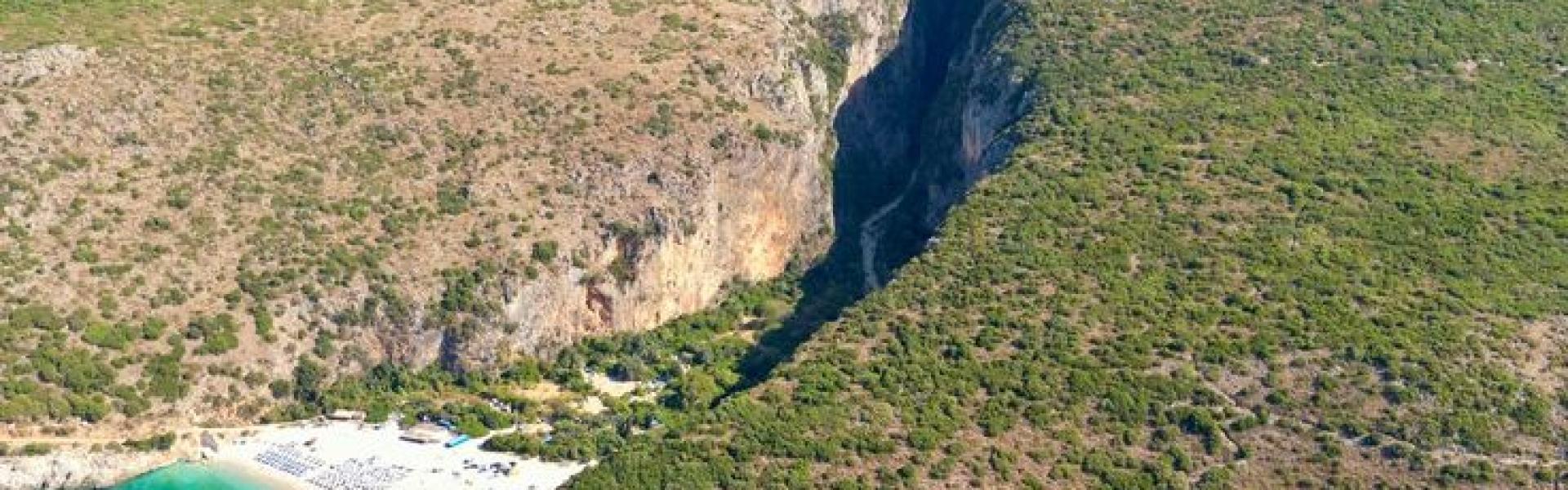
Gjipe is a small curve of white pebbles and fine sand at the exact point where the Dhërmi–Vuno stretch of the Albanian Riviera opens into a deep limestone canyon. Vertical cliffs rise on either side of a cleft about thirty metres wide, the sea inside is turquoise and drops away within a few metres of the shore, and the whole cove has stayed unspoilt for one reason: no road reaches it.
The Ceraunian Mountains cut inland for several kilometres in a dry, dramatic gorge that ends abruptly at this beach. On the cliff above, the roofless ruins of the Monastery of St Theodore look down over the water. There is a single summer bar and a small campsite behind the pebbles, and that is the entire built environment. Most visitors come on foot from the SH8 turn-off; a growing number arrive by boat taxi from Himarë or Jal for a half-day of swimming and snorkelling.
Getting to Gjipe
By car + walk from the SH8 turn-off
The Gjipe turn-off is signposted on the SH8 coastal road between Dhërmi and Vuno, roughly 220 km south of Tirana. The dirt track is driveable for about the first kilometre in a robust car (a 4x4 helps in wet weather). After that, park and walk the final 30–40 minutes downhill through olive groves and pines, with the canyon opening in front of you. The return uphill in summer heat is significantly harder, so start the walk-out before 11:00 or after 17:00.
By boat taxi from Himarë or Jal
The most comfortable option in July and August. Wooden boats leave Himarë harbour and Jal Beach through the day; Gjipe is about ten minutes from Jal and twenty from Dhërmi. Expect €10–20 per person one way, more for a private charter. Boats drop you directly on the pebbles, and many day-visitors walk in and take a boat out at the end of the afternoon.
Hiking the canyon from inland
In the cooler months (October to May), the Gjipe Canyon itself can be hiked as a longer route from the inland end near the village of Vuno. The gorge is dry in summer but can flood after autumn rain, so check the local forecast, and never enter with thunderstorms in the mountains. Allow 3–4 hours one way with a local guide.
Top experiences at Gjipe
The beach itself
A hundred-metre curve of white pebbles and fine sand between vertical cliffs. The water is deep almost immediately, ideal for confident swimmers. The summer bar rents a handful of umbrellas and sunbeds (€10–15 per set); the rest of the beach is free and empty by mid-afternoon.
Walking into the canyon
From the back of the beach you can walk a few hundred metres up the dry riverbed into the canyon, between limestone walls that close overhead as you go. No technical skill needed for the first stretch, just trainers with grip. In summer the gorge is dry and cool in shade, a natural counterpoint to the sun on the pebbles.
Monastery of St Theodore ruins
A short but steep climb up the ridge to the west of the beach reaches the roofless ruins of a small Orthodox monastery on a rocky outcrop. Little remains beyond the church foundations and parts of the walls, but the view along the coast is one of the finest on the Riviera. Allow 40 minutes round trip; wear proper shoes.
Snorkelling along the cliffs
Water clarity is among the best on the Albanian coast. Swim out along either cliff wall for rocks, small fish, and the occasional octopus in shallow crevices. There is no coral, but the underwater relief and light on the limestone are the point. Bring your own mask and fins.
Practical tips
Bring supplies. The single summer bar sells drinks, snacks and simple sandwiches at inflated prices; there are no shops, no ATMs, no medical facilities. Carry at least two litres of water per person, sun cream, a hat, and something for lunch.
Shade is limited. The cliffs cast the beach in the early morning and late afternoon, but between 11:00 and 16:00 the pebbles are exposed. Bring an umbrella or plan around the shadow line.
Shoulder season is best. June and September combine warm sea (22–25 °C), long daylight and empty pebbles. July and August are hotter, busier and much harder for the walk in and out. In October, high-tide waves can reach the back of the beach; check the forecast.
Camping. The small site behind the beach opens roughly mid-June to mid-September, with tent pitches and basic facilities. No booking system; arrive early.
Nearby destinations
Gjipe sits at the heart of the Albanian Riviera, within 30 minutes of the coast's best-known beaches and villages.
Frequently asked questions
1Can you drive all the way to Gjipe Beach?
No. The dirt track from the SH8 turn-off is driveable for roughly the first kilometre in a normal car, and a little further in a 4x4. The final descent to the beach is on foot only, about 30–40 minutes downhill.
2How long is the walk down to the beach?
About 30–40 minutes downhill from the point where cars usually park, through olive groves and pines. The return uphill takes 45–60 minutes and is significantly harder in summer heat; walk it early or late in the day.
3Are there facilities on the beach?
In summer (roughly mid-June to mid-September) a single bar serves drinks, snacks and simple sandwiches, and rents a limited number of umbrellas and sunbeds. Basic toilets are attached to the campsite. There are no shops, ATMs or medical facilities; carry cash and supplies.
4What is the best time of day to visit?
Start the walk down before 10:00 to reach the beach while the cliffs still shade the pebbles. Swim through late morning, take shelter in the canyon or a rented umbrella at midday, and walk out around 17:00 as the temperature drops. Boat visitors have more flexibility.
5Is Gjipe suitable for families with young children?
The beach itself is fine for children who can swim: pebbles are smooth and the water deepens quickly. The 30–40 minute walk in and out is harder with toddlers or a stroller (impossible for a stroller). Families with small children usually arrive by boat taxi from Himarë or Jal.
6Can I stay overnight at Gjipe?
Yes, at the small summer campsite behind the beach, roughly mid-June to mid-September. Tent pitches only, basic toilets and a shared shower. No booking system, no formal check-in, so arrive early. For anything more comfortable, sleep in Dhërmi, Vuno or Himarë.
7Is the Gjipe Canyon hike dangerous?
The short walk from the beach into the mouth of the canyon is easy in trainers. The full inland traverse is longer and should only be done with a local guide, in cool months, and never after heavy rain, because the gorge floods fast. Never enter with thunderstorms forecast in the mountains behind Vuno.
Ready for Albania?
Ready to visit Gjipe?
Combine Gjipe with a Riviera road trip, a Himarë boat day, or a hiking route from Vuno.
Instant online quote — free cancellation up to 48 hours before pickup.